
Top 10 Rarest Coins in the World — and What They're Worth
From an $18.87 million Gold Double Eagle to a wartime penny worth $1.7 million — the complete guide to the rarest and most valuable coins ever documented, with auction records, survival stories, and collector context.
Some coins are more than money. They are artifacts of history, politics, and craftsmanship that survived wars, economic upheaval, and the passage of centuries. The rarest coins in the world command millions at auction not just because of their gold or silver content, but because of the extraordinary stories behind their survival. Whether you are a seasoned numismatist or just beginning your journey into rare coin collecting, these ten coins represent the pinnacle of what makes this hobby so captivating.
| Rank | Coin | Record Auction Price | Known Survivors |
|---|---|---|---|
| 1 | 1933 Double Eagle | $18.87 Million | 13 (1 privately ownable) |
| 2 | 1794 Flowing Hair Silver Dollar | $10 Million | ~140 |
| 3 | 1787 Brasher Doubloon | $9.36 Million | 7 |
| 4 | 1822 Capped Bust Half Eagle | $8.4 Million | 3 |
| 5 | 1343 Edward III Florin | Est. $6.8 Million | 3 |
| 6 | 1913 Liberty Head Nickel | $4.2 Million | 5 |
| 7 | 1804 Silver Dollar Class I | $4.1 Million | 8 (Class I) |
| 8 | 2007 $1M Canadian Gold Maple Leaf | Est. $4.1 Million | 4 (one stolen) |
| 9 | 1943 Bronze Lincoln Penny | Est. $1.7 Million | Fewer than 30 |
| 10 | 1795 $10 Nine Leaves Eagle | $3.36 Million | Extremely Rare |
#1 — 1933 Double Eagle
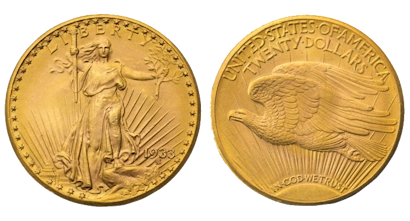
The 1933 Double Eagle holds the title of the most expensive coin ever sold at public auction. In June 2021, a single specimen crossed the block at Sotheby's New York for an astounding $18.87 million — a record that still stands today.
The coin's story begins with the Great Depression. In 1933, the U.S. Mint produced approximately 445,500 Double Eagle gold coins. However, President Franklin D. Roosevelt signed Executive Order 6102 that same year, effectively taking the United States off the gold standard and requiring citizens to surrender gold coins to the Federal Reserve. Nearly all 1933 Double Eagles were melted down before they ever entered circulation.
Only a handful survived — through a combination of official gifts, theft, and legal gray areas that took decades to resolve. Today, just 13 specimens are confirmed to exist, and only one is legally available to private collectors. The rest reside in institutional collections including the Smithsonian. For collectors interested in the broader world of U.S. gold coins, the 1933 Double Eagle represents the ultimate expression of American gold coinage — a coin that was never supposed to exist outside a vault.
#2 — 1794 Flowing Hair Silver Dollar
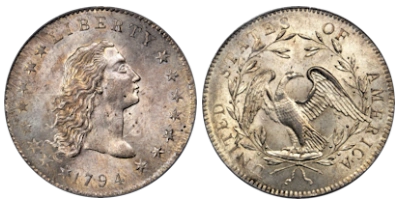
The 1794 Flowing Hair Silver Dollar is widely believed to be the very first silver dollar ever struck by the United States Mint. In 2013, a specimen graded SP-66 by PCGS sold at auction for $10 million, cementing its place among the most valuable coins in existence.
Struck in Philadelphia in October 1794, this coin carries the full symbolic weight of a young nation establishing its monetary identity. The obverse features Lady Liberty with flowing hair; the reverse displays a small eagle surrounded by a laurel wreath. The edge is inscribed "Hundred Cents One Dollar or Unit" — a declaration intended to build public trust in a new federal currency system.
Only 1,758 were ever minted in 1794, and fewer than 150 are believed to survive today. The finest known specimen's exceptional strike quality has led some researchers to theorize it may have been among the first coins personally inspected by Mint Director David Rittenhouse.
#3 — 1787 Brasher Doubloon
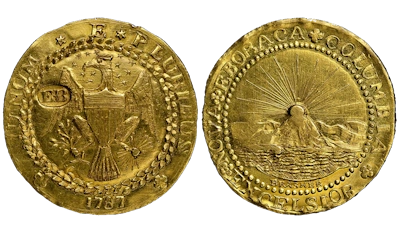
Before the United States Mint existed, private citizens sometimes took coin production into their own hands. Ephraim Brasher — a New York goldsmith who happened to live next door to Alexander Hamilton — struck a series of gold doubloons in 1787 without authorization from the state of New York, having previously petitioned for minting rights and been refused.
The Brasher Doubloon contains approximately one ounce of pure gold and bears Brasher's personal hallmark — the initials "EB" — stamped onto the eagle's breast as a primitive quality guarantee. Only seven are known to exist. The finest known specimen, graded MS-65, sold for $9.36 million in January 2021. What sets the Brasher Doubloon apart is that it predates the U.S. Mint itself — making it a foundational artifact of American monetary history rather than simply a rare government issue.
#4 — 1822 Capped Bust Half Eagle
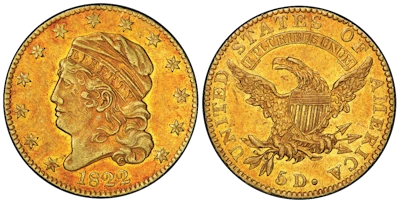
Of the 17,796 Capped Bust Half Eagles minted in 1822, only three are known to survive today — making it one of the rarest regular-issue United States gold coins in existence. The finest known specimen, graded AU50 by PCGS, sold at Stack's Bowers Galleries for $8.4 million in March 2021 — the most valuable gold coin produced by the U.S. Mint to sell at public auction.
So few survived because gold coins of this era were frequently melted and recoined as U.S. monetary policy evolved, particularly after the Coinage Act of 1834 reduced gold content in American coins. One specimen resides permanently in the Smithsonian. The auction record-holder was purchased by collector D. Brent Pogue in 1982 for $687,500 — itself a record price at the time.
#5 — 1343 Edward III Florin
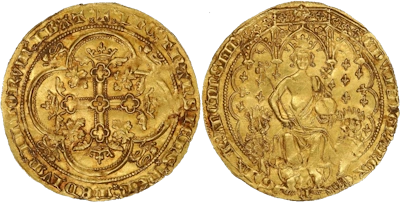
The 1343 Edward III Florin — also known as the Double Leopard — is the only coin on this list that predates the discovery of the Americas, and arguably the rarest medieval coin in existence. Only three specimens are known to survive. Issued during the reign of King Edward III of England for use in continental European trade, the coin was quickly withdrawn from circulation after being considered overvalued relative to its gold content. Most were recalled and melted.
The rediscovery of one specimen in 2006 generated worldwide numismatic headlines. The obverse shows the king enthroned in gothic splendor, flanked by leopards — the heraldic symbols of English royalty — with workmanship representing the finest goldsmithing of 14th-century England.
#6 — 1913 Liberty Head Nickel
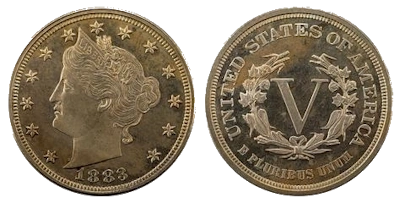
The 1913 Liberty Head Nickel is one of the most famous — and most mysterious — coins in American numismatic history. Only five specimens exist, and their very existence is unauthorized. The U.S. Mint had officially stopped producing Liberty Head Nickels in 1912, transitioning to the Buffalo Nickel design in 1913. Yet somehow five Liberty Head Nickels bearing the 1913 date were struck — without any official mint record.
The leading theory attributes their creation to Samuel W. Brown, a mint employee who had access to the dies. One famously appeared in an episode of Hawaii Five-O in 1973. Another was stolen from a North Carolina museum in 2005. At auction, examples have commanded up to $4.2 million — remarkable for a coin that was never supposed to exist at all.
#7 — 1804 Silver Dollar Class I
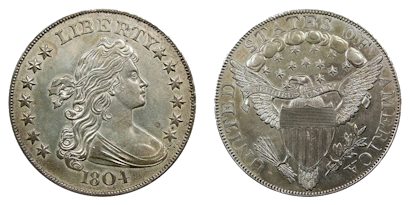
Known as the "King of American Coins," the 1804 Silver Dollar is one of the most celebrated rarities in U.S. numismatics — and one of the most misunderstood. Despite bearing the date 1804, these coins were actually struck around 1834, produced as diplomatic gift sets ordered by the State Department for foreign rulers including the Sultan of Muscat and the King of Siam, as the U.S. sought to strengthen trade relationships in Asia and the Middle East.
Class I coins — eight are known — represent the original 1834 diplomatic strikings and are considered the finest and most historically significant. Fewer than twenty specimens of all three classes combined exist. Each has a documented chain of ownership stretching back to its original diplomatic presentation.
#8 — 2007 $1 Million Canadian Gold Maple Leaf
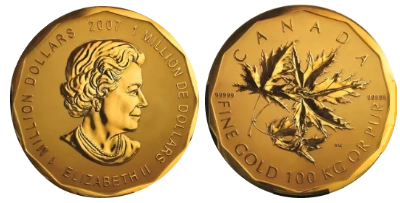
Not all rare coins are ancient. The 2007 $1 Million Canadian Gold Maple Leaf is a modern marvel — a 100-kilogram gold coin struck to 99.999% purity, the highest achievable in commercial gold refining. Produced by the Royal Canadian Mint as a showcase of Canadian metallurgical excellence, the coin measures 50 centimeters in diameter. Only five were originally produced.
One specimen was famously stolen from the Bode Museum in Berlin in 2017 in an audacious heist that made international headlines — three suspects were convicted, but the coin was never recovered. The surging price of gold has pushed the remaining examples' market values well above $4 million each.
#9 — 1943 Bronze Lincoln Penny
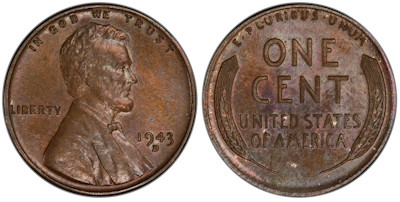
The 1943 Bronze Lincoln Penny proves the most valuable coins are not always made of gold. During World War II, the U.S. Mint switched from bronze to zinc-coated steel to conserve copper for wartime ammunition. A small number of bronze planchets left over from 1942 production accidentally made their way into the presses before the changeover was complete, producing a tiny population of 1943-dated bronze pennies — a minting error of extraordinary consequence.
Fewer than 30 are estimated to exist across all three mints, with the 1943-D (Denver) being the rarest with only one confirmed example. It is also one of the most counterfeited coins in American history — the most common forgeries involve copper-plating genuine steel cents or altering dates on 1948 bronze pennies. A genuine 1943 bronze cent is not magnetic; if your 1943 penny doesn't stick to a magnet, have it professionally examined immediately.
#10 — 1795 $10 Nine Leaves Eagle
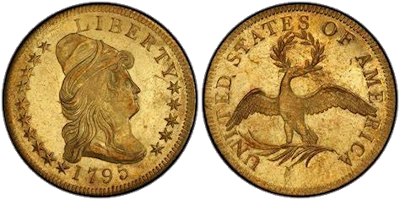
The 1795 $10 Eagle "Nine Leaves" variety is the rarest of all Small Eagle type gold coins and one of the most significant pieces of early American monetary history. In January 2022, a specimen sold for $3.36 million, underscoring its enduring desirability among serious collectors of early U.S. coinage.
Among the first gold coins struck by the newly established U.S. Mint in Philadelphia, the Nine Leaves variant differs from the more common Thirteen Leaves version in a subtle but critical way: the reverse wreath contains nine leaves rather than thirteen — a variation that dramatically reduces known survivors and elevates its rarity. Referred to by experts as the "King of the Small Eagle type," this coin showcases the earliest technical achievements of U.S. Mint engravers working under difficult conditions with limited tools.
What Makes a Coin Rare and Valuable?
The coins on this list share several characteristics that drive their extraordinary values. Understanding these factors helps any collector evaluate the potential of coins in their own collection.
The fewer examples that exist, the more valuable the coin. Mass melting events — wartime metal drives, monetary policy changes, economic necessity — destroyed the overwhelming majority of many early issues.
Coins representing a pivotal moment in history — the first year of a denomination, a wartime error, an unauthorized strike — carry value beyond metal content. They are artifacts as much as currency.
PCGS and NGC grades run from 1 to 70. A coin graded MS-65 can be worth ten times the same coin in VF-30. For the coins on this list, the difference between grades can be worth millions of dollars.
A documented ownership history adds significant value. The 1804 Silver Dollar's diplomatic pedigree and the 1822 Half Eagle's journey through legendary collections are as much part of their value as their physical characteristics.
Browse rare U.S. coins and key dates from certified sellers — PCGS and NGC authenticated.
Shop Rare Certified Coins on eBay
Shop Rare Gold Coins on eBay
Frequently Asked Questions
What is the most expensive coin ever sold?
How can I tell if a 1943 penny is the rare bronze version?
Why were 1933 Double Eagles never released into circulation?
What is the rarest coin that a typical collector could realistically own?
Does condition really matter that much for ultra-rare coins?
More at FindRareCoins.com: 1933 Gold Double Eagle · 1909-S VDB Lincoln Cent · Mint Error Coins · Investing in Rare Coins · Gold Rush Coins
 '
'