
🏅 From 1892 to Today
U.S. Commemorative Coins: History, Key Issues & Collector's Guide
Since 1892, the United States Mint has struck commemorative coins to honor pivotal moments, landmark figures, and enduring institutions in American history. More than a collector's niche, commemorative coins are miniature monuments — each one authorized by Congress, designed by artists, and minted in limited quantities that make them genuinely scarce the moment production ends. Since the modern program's revival in 1982, these coins have raised over $500 million for causes ranging from veterans' memorials to civil rights education.
What Is a U.S. Commemorative Coin?
A commemorative coin is a legal tender coin issued by the U.S. Mint for a specific, congressionally authorized purpose — typically to mark an anniversary, honor a historical figure, support a charitable cause, or celebrate a national institution. Unlike circulation coins, commemoratives are struck in limited quantities, sold at a premium above face value, and not intended for everyday use.
The surcharge on each commemorative coin — typically $10 above face value for silver dollars — is directed to a designated organization or fund tied to the coin's theme. The Lincoln Memorial, the Vietnam Veterans Memorial, the U.S. Olympic Committee, and hundreds of other institutions have received funding through the commemorative coin program. For collectors, this built-in scarcity and purposeful design make commemoratives a uniquely meaningful area of numismatics.
Commemoratives differ from standard bullion coins like the American Gold Eagle or American Silver Eagle — those are issued annually in large quantities primarily for investment. Commemoratives are issued once per program, in limited numbers, with designs that will never be repeated.
The Early Commemorative Era (1892–1954)
The early commemorative era produced some of the most artistically ambitious and historically rich coins in American numismatic history — along with some cautionary lessons about market saturation that would shape the program's future.

1892 Columbian Half Dollar
The first U.S. commemorative coin — issued for the 400th anniversary of Columbus's voyage to America and sold at the World's Columbian Exposition in Chicago. It established the template for all commemoratives that followed: limited mintage, event-tied issuance, and sale at a premium. Over 5 million were struck across 1892 and 1893, making it one of the most available early commemoratives today.
Shop on eBay
1915 Panama-Pacific Set
One of the most iconic commemorative sets in U.S. history — five coins issued for the Panama-Pacific International Exposition in San Francisco, celebrating the opening of the Panama Canal. The set included the extraordinary octagonal $50 gold piece, the only non-circular coin ever produced by the U.S. Mint. The round $50 gold piece from this set is one of the rarest and most valuable commemoratives ever struck.
Shop on eBay
1921 Peace Dollar
Designed by Anthony de Francisci, the Peace Dollar commemorated the end of World War I while serving as a circulating coin — a rare dual-purpose issue. Lady Liberty wears a radiant crown on the obverse; a perched eagle at rest on the reverse. The high-relief 1921 is the key date of the entire Peace Dollar series, with significantly lower mintage than subsequent years and a distinct design that was modified for easier striking in 1922.
Shop on eBay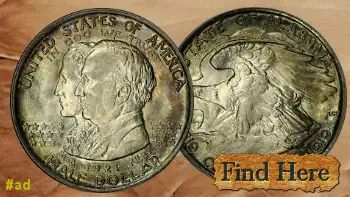
1921 Alabama Centennial Half Dollar
A landmark coin in two respects: it was the first U.S. coin to feature living individuals (Governors William Bibb and Thomas Kilby), and it was designed by Laura Gardin Fraser — the first woman to design a U.S. coin. Fraser's work was widely admired, yet her gender meant she faced repeated institutional barriers in the numismatic world. The Alabama half dollar stands as both a state commemorative and a milestone in the history of American coin design.
Shop on eBay
1918 Illinois Centennial Half Dollar
Issued to commemorate Illinois's 100th anniversary of statehood, this half dollar features a commanding portrait of Abraham Lincoln — the Land of Lincoln's most famous son. Designed by George T. Morgan, chief engraver of the U.S. Mint, it was struck at the Philadelphia Mint with a total mintage of 100,058. High-grade certified examples in MS-65 and above are scarce and command strong collector premiums.
Shop on eBay
Oregon Trail Memorial Half Dollar (1926–1939)
One of the most artistically celebrated commemoratives of the early era — featuring a Native American figure on the obverse and a Conestoga wagon on the reverse, representing the spirit of westward expansion. Issued across multiple years and mint marks between 1926 and 1939, the series has numerous date-and-mint combinations that make building a complete set a rewarding challenge for collectors. The 1926-S is the most affordable; the 1939-D is the key date.
Shop on eBay
Booker T. Washington Half Dollar (1946–1951)
One of the first U.S. coins to honor an African American, the Booker T. Washington Memorial Half Dollar was issued across multiple years and all three active mint facilities — Philadelphia, Denver, and San Francisco. Despite its historical significance, the series was poorly marketed and oversaturated the market, contributing to Congress's decision to suspend commemorative coinage entirely from 1954 to 1982.
Shop on eBay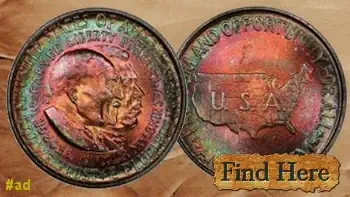
Washington-Carver Half Dollar (1951–1954)
The final commemorative of the early era — a combined portrait coin honoring both Booker T. Washington and George Washington Carver. Like the BTW halves that preceded it, this series suffered from uninspired marketing and excessive mintings across multiple mint facilities and years. Congress grew frustrated with commemoratives being used primarily as fundraising vehicles rather than genuine historical tributes, leading to the program's suspension after 1954.
Shop on eBayThe Modern Commemorative Era (1982–Present)
When Congress revived the commemorative coin program in 1982, it did so with new safeguards: each program is individually authorized by legislation, limited to a single year of issue, and subject to design review by the Citizens Coinage Advisory Committee (CCAC) and the Commission of Fine Arts (CFA). The result has been a more disciplined program that has maintained collector interest and generated over $506 million in surcharges for designated causes.
| Year | Coin / Program | Significance | Beneficiary |
|---|---|---|---|
| 1982 | George Washington 250th Anniversary Half Dollar | First modern commemorative. Designed by Elizabeth Jones. Washington on horseback / Mount Vernon. | Mount Vernon restoration |
| 1986 | Statue of Liberty Centennial | Celebrated the monument's 100th anniversary. Clad half dollar, silver dollar, and gold $5 issued. | Ellis Island / Statue restoration |
| 1995–96 | Olympic Centennial Series | 32-coin program for the 100th anniversary of the modern Olympics and 1996 Atlanta Games — the largest modern commemorative program. | U.S. Olympic Committee |
| 1997 | Jackie Robinson Commemorative | Honored Robinson's legacy in breaking baseball's color barrier. Gold $5 and silver dollar issued. | Jackie Robinson Foundation |
| 2000 | Library of Congress Bimetallic Eagle | The first U.S. coin struck in both gold and platinum — a $10 bimetallic issue for the Library's bicentennial. | Library of Congress |
| 2005 | Marine Corps 230th Anniversary Dollar | Silver dollar sold out faster than almost any modern commemorative in program history. | Marine Corps Heritage Foundation |
| 2020 | Women's Suffrage Centennial Silver Dollar | 100th anniversary of the 19th Amendment. Depicts diverse women stepping forward together. | Smithsonian Institution |
| 2024 | Harriet Tubman Commemorative Program | Birth bicentennial of Tubman. Includes gold $5, silver $1, and clad half dollar — each depicting different aspects of her life and legacy. | Designated civil rights organizations |
🏅 Shop U.S. Commemorative Coins on eBay
Find early and modern commemoratives — from 1892 Columbian halves to Olympic series coins — from trusted dealers and certified sellers.
How Commemorative Coins Are Made: The Legislative & Minting Process
Every U.S. commemorative coin begins not at the Mint, but in Congress. The process from proposal to finished coin typically takes two to four years and involves multiple layers of approval and artistic review — a system designed specifically to prevent the abuses of the early era.
Congressional Authorization
A bill must be introduced in Congress specifying the coin's subject, denominations, mintage limits, surcharge amounts, and the organization that will receive the proceeds. The bill must pass both chambers and be signed into law by the President.
Design Development
The U.S. Mint solicits design concepts from Mint engravers, outside artists, and student competitions. Multiple candidate designs are developed for each denomination, considering both the obverse and reverse concepts specified or implied in the authorizing legislation.
CCAC and CFA Review
The Citizens Coinage Advisory Committee (CCAC) reviews and ranks all design candidates, providing formal recommendations. The Commission of Fine Arts (CFA) also reviews designs from an artistic standpoint. Both bodies provide recommendations — though final authority rests with the Secretary of the Treasury.
Final Approval
The Secretary of the Treasury reviews CCAC and CFA recommendations and selects the final designs. For coins featuring living individuals or sitting presidents, additional approvals may be required.
Die Production & Striking
Approved designs are transferred to master hubs and then working dies. Commemoratives are struck on specially prepared planchets to Proof or Uncirculated standards, using higher striking pressures than circulation coins to achieve sharper relief and finer detail.
Quality Control & Packaging
Each coin is individually inspected. Proof coins are handled with cotton gloves and encapsulated. All commemoratives are packaged with a certificate of authenticity and sold directly through the U.S. Mint's website and authorized dealers at the congressionally mandated price.
Collecting Commemorative Coins: What to Know
Commemorative coins occupy a unique position in numismatics — they combine the appeal of limited-edition art objects with documented mintage data, government-guaranteed metal content, and often a direct connection to important historical events or causes the collector cares about personally.
What Collectors Look for in Commemoratives
- Low mintage vs. high demand — coins that sold out quickly at issue tend to carry long-term premiums (e.g., the 2005 Marine Corps dollar)
- First-year issues — the 1982 Washington half dollar and 1986 Statue of Liberty series are cornerstones of modern commemorative collecting
- Complete sets — multi-coin programs like the 1995–96 Olympics offer a building-a-set challenge that appeals to systematic collectors
- Key early era dates — the 1915 Panama-Pacific $50 gold pieces are among the most historically significant and valuable commemoratives ever struck
- PCGS and NGC certification — high-grade certified examples (MS-69, MS-70, or PR-70) command the strongest premiums in the secondary market
- Historical significance — coins tied to landmark events (women's suffrage, civil rights figures, wartime) attract both collectors and history enthusiasts
Continue Exploring U.S. Coinage History
- The Top 10 Rarest Coins in U.S. History
- U.S. Gold Coins: Complete Guide
- $5 Gold Half Eagle Coins
- 1909-S VDB Lincoln Cent
- Investing in Rare Coins
Frequently Asked Questions: Commemorative Coins
🏅 Explore U.S. Commemorative Coins
From 1892 Columbian halves to modern silver dollars — find certified and raw commemoratives from trusted eBay sellers and Amazon dealers.
 '
'