Jefferson Nickel Value Chart
Jefferson Nickel • 1938–Present • War Nickels • Key Dates • Full Steps
Most Valuable Jefferson Nickels & Related Guides
The Jefferson Nickel — America's Longest-Running Nickel Design
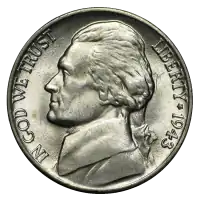
The Jefferson nickel has been in continuous production longer than any other U.S. coin design, striking from 1938 to the present day with only modest design updates along the way. Designed by Felix Schlag following an open competition, the coin features a portrait of Thomas Jefferson on the obverse and his home Monticello on the reverse — a design that remained essentially unchanged for over six decades before updates in 2004–2005 and a refined portrait in 2006.
For collectors, the Jefferson nickel series divides into three distinct collecting areas: the pre-war copper-nickel issues (1938–1942), the wartime silver alloy "war nickels" (1942–1945) that contain 35% silver and carry a large mintmark above Monticello, and the post-war copper-nickel issues (1946–present). The key dates are relatively modest compared to the Buffalo nickel, but the Full Steps (FS) designation — awarded when all six steps of Monticello are fully struck and separated — creates a powerful parallel premium market where common dates in MS-65 FS can be worth 5–20x their non-FS counterparts. For silver melt value on war nickels, use our silver melt calculator.
Jefferson Nickel Key Dates & Notable Issues
The Jefferson nickel has fewer dramatic key dates than the Buffalo nickel, but several dates stand out — particularly the 1950-D, which was hoarded immediately upon release and remains the series' defining key date. The 1939-D is a significant semi-key. War nickels carry silver content that gives common dates a floor value above face value. And in the Full Steps market, many "common" dates become genuine rarities.
1950-D Jefferson Nickel
Only 2,630,030 struck at Denver — the lowest-mintage Jefferson nickel in the entire series. Collectors hoarded rolls upon release, so many examples are in high Mint State grades. Good circulated examples are relatively common; the real action is in MS-65 FS territory.
F-12: $9 · MS-63: $20 · MS-65 FS: $800+1939-D Jefferson Nickel
3,514,000 struck — the second-lowest mintage in the series and a genuine semi-key. Most examples are heavily worn. The 1939-D is the most difficult pre-war date to find in Mint State with Full Steps — MS-65 FS examples are extremely rare.
F-12: $16 · MS-63: $90 · MS-65 FS: $12,000+1942-D Over Horizontal D
A 1942-D die had a horizontal mintmark corrected with a vertical D punched over it — the underlying horizontal D is visible on close examination. One of the most popular Jefferson nickel varieties. PCGS VarietyPlus and CONECA both attribute this variety.
F-12: $80 · VF: $140 · MS-63: $500+1938-D & 1938-S
First-year issues from Denver and San Francisco — low mintages (5,376,000 and 4,105,000 respectively) combined with first-year collector interest make these semi-keys. The 1938-S is the scarcer of the two in gem condition with Full Steps.
F-12: $4–6 · MS-63: $18–28 · MS-65 FS: $800–2,000+War Nickels (1942–1945)
Six issues struck in 35% silver alloy during WWII — identified by a large mintmark (P, D, or S) above Monticello. All carry silver melt value (~$1.00–$1.20 per coin at current spot). The 1942-P is the first wartime silver nickel; all six are actively collected as a sub-series.
Melt: ~$1.10 · MS-63: $10–25 · MS-65 FS: $150–2,500+1964 SMS (Special Mint Set)
A small number of 1964 Special Mint Set Jefferson nickels were struck with a higher standard of care than business strikes — sharper strikes, more reflective fields. Authenticated SMS examples are worth $50–$150+. Not all "special looking" 1964 nickels qualify.
MS-65: $50 · SMS-65: $100–$150+Complete Jefferson Nickel Value Chart (1938–1964)
Values below cover the classic Jefferson nickel era through 1964 — the period that defines the numismatic series. Post-1964 Jefferson nickels are generally worth face value in circulated grades with the exception of Full Steps certified examples. FS = Full Steps designation from PCGS or NGC. War nickels (1942–1945) are noted with their silver content. For live silver melt value on war nickels use our silver melt calculator.
| Date | G-4 | F-12 | VF-20 | EF-40 | MS-63 | MS-65 | MS-65 FS | Shop |
|---|---|---|---|---|---|---|---|---|
| 1938-P | $2 | $3 | $4 | $6 | $16 | $38 | $160 | eBay → |
| 1938-D | $3 | $4 | $6 | $9 | $24 | $55 | $800 | eBay → |
| 1938-S | $3 | $5 | $7 | $10 | $28 | $65 | $2,000 | eBay → |
| 1939-P | $1 | $2 | $3 | $5 | $14 | $32 | $120 | eBay → |
| 1939-D SEMI-KEY | $12 | $16 | $24 | $38 | $90 | $220 | $12,000+ | eBay → |
| 1939-S | $2 | $3 | $5 | $8 | $22 | $50 | $550 | eBay → |
| 1940-P | $0.50 | $1 | $2 | $3 | $10 | $22 | $80 | eBay → |
| 1940-D | $0.75 | $1 | $2 | $4 | $12 | $28 | $200 | eBay → |
| 1940-S | $0.50 | $1 | $2 | $3 | $10 | $22 | $120 | eBay → |
| 1941-P | $0.50 | $1 | $2 | $3 | $10 | $22 | $80 | eBay → |
| 1941-D | $0.75 | $1 | $2 | $4 | $12 | $28 | $180 | eBay → |
| 1941-S | $0.75 | $1 | $2 | $4 | $12 | $28 | $400 | eBay → |
The 1939-D is the most difficult pre-war Jefferson nickel to find in Mint State FS — fewer than 20 examples are known above MS-65 FS.
Shop 1938–1941 →| Date | Silver Melt | F-12 | VF-20 | EF-40 | MS-63 | MS-65 | MS-65 FS | Shop |
|---|---|---|---|---|---|---|---|---|
| 1942-P 35% SILVER | ~$1.10 | $3 | $5 | $8 | $18 | $40 | $200 | eBay → |
| 1942-D/D VARIETY | — | $80 | $140 | $220 | $500 | $1,400 | — | eBay → |
| 1943-P 35% SILVER | ~$1.10 | $3 | $4 | $7 | $16 | $36 | $160 | eBay → |
| 1943-D 35% SILVER | ~$1.10 | $3 | $5 | $8 | $18 | $40 | $220 | eBay → |
| 1943-S 35% SILVER | ~$1.10 | $3 | $5 | $8 | $18 | $40 | $2,500 | eBay → |
| 1944-P 35% SILVER | ~$1.10 | $3 | $4 | $7 | $16 | $36 | $160 | eBay → |
| 1944-D 35% SILVER | ~$1.10 | $3 | $5 | $8 | $18 | $40 | $220 | eBay → |
| 1944-S 35% SILVER | ~$1.10 | $3 | $5 | $8 | $18 | $40 | $400 | eBay → |
| 1945-P 35% SILVER | ~$1.10 | $3 | $4 | $7 | $16 | $36 | $160 | eBay → |
| 1945-D 35% SILVER | ~$1.10 | $3 | $5 | $8 | $18 | $40 | $220 | eBay → |
| 1945-S 35% SILVER | ~$1.10 | $3 | $5 | $8 | $18 | $40 | $400 | eBay → |
War nickels contain 35% silver — identified by the large mintmark above Monticello. All 11 issues are worth above face value even in worn condition.
Shop War Nickels →| Date | G-4 | F-12 | VF-20 | EF-40 | MS-63 | MS-65 | MS-65 FS | Shop |
|---|---|---|---|---|---|---|---|---|
| 1946-P | $0.25 | $0.50 | $1 | $2 | $8 | $18 | $60 | eBay → |
| 1946-D | $0.25 | $0.50 | $1 | $2 | $8 | $18 | $80 | eBay → |
| 1946-S | $0.25 | $0.50 | $1 | $2 | $9 | $20 | $100 | eBay → |
| 1947-P | $0.25 | $0.50 | $1 | $2 | $8 | $18 | $60 | eBay → |
| 1947-D | $0.25 | $0.50 | $1 | $2 | $8 | $18 | $80 | eBay → |
| 1947-S | $0.25 | $0.50 | $1 | $2 | $9 | $20 | $120 | eBay → |
| 1948-P | $0.25 | $0.50 | $1 | $2 | $8 | $18 | $60 | eBay → |
| 1948-D | $0.25 | $0.50 | $1 | $2 | $8 | $18 | $80 | eBay → |
| 1948-S | $0.25 | $0.50 | $1 | $2 | $9 | $20 | $220 | eBay → |
| 1949-P | $0.50 | $1 | $2 | $3 | $10 | $22 | $180 | eBay → |
| 1949-D | $0.50 | $1 | $2 | $3 | $10 | $22 | $120 | eBay → |
| 1949-S | $1 | $2 | $3 | $5 | $14 | $32 | $600 | eBay → |
| 1950-D KEY | $6 | $9 | $12 | $16 | $20 | $42 | $800 | eBay → |
| 1951-P | $0.25 | $0.50 | $1 | $2 | $8 | $18 | $80 | eBay → |
| 1951-D | $0.25 | $0.50 | $1 | $2 | $8 | $18 | $120 | eBay → |
| 1951-S | $1 | $2 | $3 | $5 | $14 | $32 | $400 | eBay → |
| 1952-P | $0.25 | $0.50 | $1 | $2 | $8 | $18 | $60 | eBay → |
| 1952-D | $0.25 | $0.50 | $1 | $2 | $8 | $18 | $80 | eBay → |
| 1952-S | $1 | $2 | $3 | $5 | $14 | $32 | $350 | eBay → |
| 1953-P | $0.25 | $0.50 | $1 | $2 | $8 | $18 | $60 | eBay → |
| 1953-D | $0.25 | $0.50 | $1 | $2 | $8 | $18 | $60 | eBay → |
| 1953-S | $0.50 | $1 | $2 | $3 | $10 | $22 | $180 | eBay → |
| 1954-P | $0.25 | $0.50 | $1 | $2 | $8 | $18 | $55 | eBay → |
| 1954-D | $0.25 | $0.50 | $1 | $2 | $8 | $18 | $55 | eBay → |
| 1954-S | $0.50 | $1 | $2 | $3 | $10 | $22 | $160 | eBay → |
| 1955-P | $0.50 | $1 | $2 | $3 | $10 | $22 | $80 | eBay → |
| 1955-D | $0.25 | $0.50 | $1 | $2 | $8 | $18 | $60 | eBay → |
| 1956-P | $0.15 | $0.25 | $0.50 | $1 | $6 | $14 | $45 | eBay → |
| 1956-D | $0.15 | $0.25 | $0.50 | $1 | $6 | $14 | $45 | eBay → |
| 1957-P | $0.15 | $0.25 | $0.50 | $1 | $6 | $14 | $45 | eBay → |
| 1957-D | $0.15 | $0.25 | $0.50 | $1 | $6 | $14 | $45 | eBay → |
| 1958-P | $0.15 | $0.25 | $0.50 | $1 | $6 | $14 | $45 | eBay → |
| 1958-D | $0.15 | $0.25 | $0.50 | $1 | $6 | $14 | $45 | eBay → |
| 1959-P | $0.10 | $0.20 | $0.35 | $0.75 | $5 | $12 | $38 | eBay → |
| 1959-D | $0.10 | $0.20 | $0.35 | $0.75 | $5 | $12 | $38 | eBay → |
| 1960-P | $0.10 | $0.20 | $0.35 | $0.75 | $5 | $12 | $38 | eBay → |
| 1960-D | $0.10 | $0.20 | $0.35 | $0.75 | $5 | $12 | $38 | eBay → |
| 1961-P | $0.10 | $0.20 | $0.35 | $0.75 | $5 | $12 | $38 | eBay → |
| 1961-D | $0.10 | $0.20 | $0.35 | $0.75 | $5 | $12 | $38 | eBay → |
| 1962-P | $0.10 | $0.20 | $0.35 | $0.75 | $5 | $12 | $38 | eBay → |
| 1962-D | $0.10 | $0.20 | $0.35 | $0.75 | $5 | $12 | $38 | eBay → |
| 1963-P | $0.10 | $0.20 | $0.35 | $0.75 | $5 | $12 | $38 | eBay → |
| 1963-D | $0.10 | $0.20 | $0.35 | $0.75 | $5 | $12 | $38 | eBay → |
| 1964-P | $0.10 | $0.20 | $0.35 | $0.75 | $5 | $12 | $38 | eBay → |
| 1964-D | $0.10 | $0.20 | $0.35 | $0.75 | $5 | $12 | $38 | eBay → |
The 1950-D is the key date of the series — hoarded in rolls, so Mint State examples are plentiful but FS examples remain elusive.
Shop 1946–1964 →Full Steps (FS) — What It Means & Why It Matters
The Full Steps designation is the defining premium category in Jefferson nickel collecting. The reverse of the Jefferson nickel depicts the portico of Monticello with six steps leading up to the entrance. On a fully struck coin, all six steps are complete, fully separated, and clearly defined across the full width of the coin. PCGS and NGC both designate this as FS (Full Steps).
Why FS Commands a Premium
Jefferson nickels are notoriously weakly struck — the step detail requires maximum die pressure and perfectly prepared planchets. Most coins show only 4 or 5 steps. A fully struck 6-step example is genuinely scarce for most dates. In MS-65 FS, even "common" dates can be worth $40–$200+.
How to Identify Full Steps
Under 5x magnification, count the horizontal lines on the steps of Monticello. Six complete, separated lines across the full width of the staircase qualifies as Full Steps. Partial steps — where lines fade toward one edge — do not qualify. Only PCGS FS or NGC FS designated coins should command FS premiums.
Most Valuable FS Dates
The 1939-D MS-65 FS is the holy grail — fewer than 20 known, worth $12,000+. The 1943-S MS-65 FS is worth $2,500+. The 1938-S MS-65 FS is worth $2,000+. These are dates where sharply struck coins were simply not preserved in quantity.
FS vs Non-FS Premium Gap
Common 1960s dates in MS-65: $12 without FS, $38 with FS — roughly 3x. Semi-key dates: 5–10x. The 1939-D is the extreme example — MS-65 without FS is worth $220, MS-65 FS is worth $12,000+ — a 55x premium for the designation.
Buying FS Coins
Only buy PCGS FS or NGC FS designated examples — self-attributed "full steps" coins in raw holders are frequently incorrect. The step detail requires expert examination under proper lighting. Never pay FS prices for an undesignated coin regardless of how sharp it appears to the naked eye.
Building a FS Collection
A complete Jefferson nickel set in MS-65 FS is one of the most challenging goals in 20th-century numismatics. The pre-war dates (1938–1942) and the war nickels present the greatest difficulty. The 1939-D in particular may require years of searching at auction — the population is simply that small.
Shop Jefferson Nickels on eBay
Browse certified PCGS and NGC Jefferson nickels — key dates, Full Steps designated gems, war nickels, and complete date sets from specialist dealers nationwide.
📚 Jefferson Nickel References on AmazonFindRareCoins.com participates in the eBay Partner Network and Amazon Associates program.
Where to Buy Jefferson Nickels
Certified Dealers · War Nickel Silver · Full Steps Specialists
For key dates and FS designated coins, PCGS or NGC certification is essential. War nickels are safe to buy raw given their silver content can be confirmed by the large mintmark above Monticello. Common circulated Jefferson nickels are worth face value or very near it in any condition.
eBay — Certified Jefferson Nickels
The broadest market for certified Jefferson nickels — filter to PCGS or NGC and search specifically for FS-designated examples. Check sold listings to verify current market prices on key dates and FS gems.
Shop Certified on eBay →JM Bullion
JM Bullion carries war nickel rolls and individual coins priced near silver melt value. Good source for investors wanting 35% silver nickels as a bullion position alongside common-date Jefferson nickels.
Shop JM Bullion →1950-D & 1939-D on eBay
The 1950-D and 1939-D are the key dates most likely to be overpriced in raw condition. Filter to certified examples for confident purchases. Heritage Auctions handles the finest examples at auction.
Find Key Dates on eBay →Money Metals Exchange
Money Metals Exchange offers war nickel rolls and Jefferson nickel lots with no minimum order. Good for investors buying 35% silver war nickels in quantity at competitive premiums over melt.
Shop Money Metals →PCGS FS-Designated on eBay
Search eBay specifically for PCGS FS-designated Jefferson nickels to find authenticated Full Steps examples. The FS designation must appear on the certification label — never pay FS premiums for undesignated coins.
Shop PCGS FS →Jefferson Nickel References on Amazon
John Wexler and Kevin Flynn's authoritative Jefferson nickel references cover die varieties, Full Steps attribution standards, and complete population data. Essential reading for serious Jefferson collectors.
Browse Amazon →Related Coin Value Guides
Frequently Asked Questions
What is the most valuable Jefferson nickel?
In terms of basic date-and-grade value, the 1939-D is the most valuable pre-war Jefferson nickel in Mint State — MS-65 without Full Steps is worth $220, and MS-65 FS is worth $12,000+. The 1950-D is the defining key date of the series with the lowest mintage, though its value in circulated grades ($6–$16) is modest because collectors hoarded rolls in 1950. The 1942-D over horizontal D variety is the most valuable die variety. In the FS market, the 1939-D MS-65 FS and 1943-S MS-65 FS are the two most coveted individual coins.
How do I identify a war nickel?
War nickels (1942–1945) are identified by a large mintmark — P, D, or S — positioned above the dome of Monticello on the reverse. Standard Jefferson nickels have a small mintmark to the right of Monticello (or no mintmark for Philadelphia issues). The large above-dome mintmark is the definitive identifier. War nickels also contain 35% silver, giving them a melt value of approximately $1.10 at $25/oz silver spot — use our silver melt calculator for the live figure. They look slightly different in hand — the silver alloy gives them a warmer, slightly different luster than the copper-nickel issues.
What does Full Steps mean on a Jefferson nickel?
Full Steps (FS) refers to complete, fully separated steps on the portico of Monticello on the reverse. Six horizontal steps lead up to the entrance of Monticello — on a fully struck coin, all six are completely defined and separated across the full width. Jefferson nickels are notoriously weakly struck in the step area, making fully struck examples genuinely scarce. PCGS and NGC examine coins under proper lighting and magnification to award the FS designation. Never pay Full Steps prices for an undesignated coin — only PCGS FS or NGC FS labeled coins qualify.
Why is the 1950-D Jefferson nickel valuable?
The 1950-D had a mintage of only 2,630,030 — the lowest of any Jefferson nickel. When the Mint released the 1950-D, collectors immediately recognized its low mintage and began hoarding rolls. This means that while circulated examples are scarce, Mint State examples are actually relatively available — rolls that were never spent still surface regularly. The real challenge with the 1950-D is finding a Mint State example with Full Steps, as the FS population is small despite the hoarded rolls. In terms of pure date rarity in circulated grades, the 1939-D is actually scarcer in Mint State.
Are war nickels worth saving from change?
Yes — any war nickel (1942-P, 1943-P/D/S, 1944-P/D/S, 1945-P/D/S) is worth more than face value because of its 35% silver content. At $25/oz silver spot, the melt value is approximately $1.10 per coin — 22x face value. Identifying them is easy: look for a large mintmark above Monticello on the reverse. They circulated alongside copper-nickel nickels and some still turn up in change, coin rolls, and estate finds. Use our silver melt calculator for the current live melt value.
Where can I find current Jefferson nickel prices?
This value chart is updated periodically. For real-time prices, use the PCGS Price Guide at PCGS.com (updated monthly), recent eBay sold listings filtered to certified examples, and Heritage Auctions' free price archive. The FRC coin price guide covers the Jefferson nickel series alongside all major U.S. denominations. For war nickel silver melt values, the silver melt calculator provides a live figure updated with current spot prices.
 '
'