Mercury Dime Value Chart
Winged Liberty Head Dime • 1916–1945 • Key Dates • Full Split Bands
Most Valuable Mercury Dimes & Related Guides
The Mercury Dime — America's Most Beautiful Small Coin
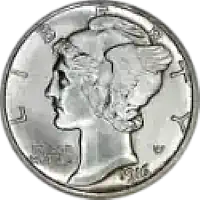
The Mercury dime — officially the Winged Liberty Head dime — was struck from 1916 through 1945 and is widely considered the finest artistic achievement in the history of American small coinage. Designed by sculptor Adolph A. Weinman, the obverse features Liberty wearing a winged cap (commonly mistaken for the Roman god Mercury, giving the coin its popular name), while the reverse depicts a fasces bound with an olive branch — symbols of unity and peace. The design was selected in a 1916 competition that also produced the Walking Liberty half dollar, also by Weinman.
For collectors, the Mercury dime series combines artistic beauty with genuine numismatic challenge. The 1916-D is one of the most famous key dates in American coinage, and the Full Split Bands (FSB) designation — awarded to coins where the horizontal bands on the reverse fasces are fully and clearly separated — creates a parallel premium market that rivals the basic date-and-grade structure. A common-date Mercury dime in MS-65 is worth $50–$80; the same coin with FSB designation is worth $300–$600. This guide covers every date from 1916 through 1945 with values for circulated and mint-state grades, FSB premiums, and the key dates that define the series.
Mercury Dime Key Dates & Their Values
Six dates define the top tier of the Mercury dime series. The 1916-D is the king — with only 264,000 struck and most heavily circulated, it is one of the most counterfeited coins in American numismatics. The 1921 and 1921-D are the two scarcest dates after the 1916-D. The 1942/1 and 1942/1-D overdate errors are the most dramatic die varieties in the series.
1916-D Mercury Dime
Only 264,000 struck at Denver — the rarest Mercury dime by far. Most examples were heavily circulated. Widely counterfeited by adding a D mintmark to 1916-P coins. PCGS or NGC certification is mandatory for any purchase.
G-4: $1,200 · VF: $4,500 · MS-63: $30,000+1921 Mercury Dime
Only 1,230,000 struck at Philadelphia — the second rarest date after the 1916-D. Most circulated heavily during the early 1920s recession. Even heavily worn examples are worth $100+. Gem examples extremely scarce.
G-4: $100 · VF: $360 · MS-63: $4,500+1921-D Mercury Dime
1,080,000 struck at Denver — slightly lower mintage than the 1921-P. Both 1921 dates are dramatically scarcer than any other Mercury dime outside the 1916-D. Collect both for a complete key date set.
G-4: $110 · VF: $400 · MS-63: $5,500+1942/1 Overdate Error
A 1941 die was used to create a 1942 die — the underlying "1" is visible beneath the "2" in the date. Philadelphia issue. One of the most dramatic and valuable die varieties in the entire Mercury dime series.
G-4: $400 · VF: $1,200 · MS-63: $8,000+1942/1-D Overdate Error
The Denver mint version of the 1942/1 overdate — slightly scarcer than the Philadelphia issue and worth more at every grade level. Both overdate varieties require 5x magnification to confirm the underlying "1" clearly.
G-4: $500 · VF: $1,500 · MS-63: $10,000+1931-D & 1931-S
Depression-era dates with low mintages — 1,260,000 (Denver) and 1,800,000 (San Francisco). Both are semi-keys that jump sharply in value above VF. The 1931-D is the scarcer of the two in gem condition.
G-4: $18 · VF: $55 · MS-65 FSB: $3,500+Complete Mercury Dime Value Chart (1916–1945)
Values below are for problem-free examples. G = Good-4, VG = Very Good-8, F = Fine-12, VF = Very Fine-20, EF = Extremely Fine-40, MS-63 = Choice Uncirculated, MS-65 = Gem Uncirculated. FSB = Full Split Bands premium — see the FSB guide below the table. Silver melt value for a Mercury dime is approximately $1.60–$1.80 at current spot prices — use our silver melt calculator for the live figure.
| Date | G-4 | VG-8 | F-12 | VF-20 | EF-40 | MS-63 | MS-65 | MS-65 FSB | Shop |
|---|---|---|---|---|---|---|---|---|---|
| 1916-P | $4 | $5 | $6 | $9 | $16 | $55 | $120 | $400 | eBay → |
| 1916-D KEY | $1,200 | $2,000 | $3,200 | $4,500 | $8,000 | $30,000 | $85,000+ | — | eBay → |
| 1916-S | $4 | $5 | $7 | $11 | $22 | $65 | $150 | $500 | eBay → |
| 1917-P | $4 | $5 | $6 | $9 | $16 | $50 | $110 | $350 | eBay → |
| 1917-D | $5 | $7 | $10 | $18 | $40 | $130 | $350 | $1,200 | eBay → |
| 1917-S | $5 | $6 | $9 | $15 | $32 | $100 | $280 | $900 | eBay → |
| 1918-P | $5 | $6 | $9 | $16 | $35 | $120 | $320 | $1,100 | eBay → |
| 1918-D | $6 | $8 | $12 | $22 | $55 | $180 | $500 | $1,800 | eBay → |
| 1918-S | $5 | $7 | $10 | $18 | $45 | $150 | $420 | $1,400 | eBay → |
| 1919-P | $4 | $5 | $7 | $10 | $20 | $65 | $160 | $550 | eBay → |
| 1919-D | $6 | $9 | $14 | $28 | $75 | $280 | $850 | $3,000 | eBay → |
| 1919-S | $5 | $8 | $12 | $22 | $60 | $220 | $650 | $2,200 | eBay → |
Looking for an early Mercury dime? The 1916-D must always be certified — altered mintmarks are extremely common.
Shop 1916–1919 →| Date | G-4 | VG-8 | F-12 | VF-20 | EF-40 | MS-63 | MS-65 | MS-65 FSB | Shop |
|---|---|---|---|---|---|---|---|---|---|
| 1920-P | $4 | $5 | $6 | $9 | $18 | $60 | $150 | $500 | eBay → |
| 1920-D | $5 | $7 | $11 | $22 | $55 | $200 | $600 | $2,200 | eBay → |
| 1920-S | $5 | $6 | $9 | $16 | $40 | $160 | $480 | $1,800 | eBay → |
| 1921-P KEY | $100 | $160 | $260 | $360 | $600 | $4,500 | $18,000 | — | eBay → |
| 1921-D KEY | $110 | $180 | $290 | $400 | $680 | $5,500 | $22,000 | — | eBay → |
| 1923-P | $4 | $5 | $6 | $9 | $16 | $55 | $120 | $380 | eBay → |
| 1923-S | $5 | $6 | $9 | $16 | $38 | $150 | $420 | $1,500 | eBay → |
| 1924-P | $4 | $5 | $6 | $9 | $18 | $60 | $140 | $480 | eBay → |
| 1924-D | $6 | $9 | $14 | $28 | $70 | $260 | $780 | $2,800 | eBay → |
| 1924-S | $5 | $7 | $11 | $20 | $50 | $200 | $600 | $2,200 | eBay → |
| 1925-P | $4 | $5 | $6 | $9 | $16 | $55 | $130 | $420 | eBay → |
| 1925-D | $7 | $10 | $16 | $32 | $80 | $300 | $900 | $3,200 | eBay → |
| 1925-S | $5 | $7 | $10 | $18 | $45 | $180 | $550 | $2,000 | eBay → |
| 1926-P | $4 | $5 | $6 | $8 | $14 | $50 | $110 | $360 | eBay → |
| 1926-D | $5 | $6 | $9 | $16 | $38 | $145 | $420 | $1,500 | eBay → |
| 1926-S SEMI-KEY | $28 | $45 | $80 | $160 | $380 | $1,800 | $6,500 | $28,000+ | eBay → |
| 1927-P | $4 | $5 | $6 | $8 | $14 | $50 | $110 | $360 | eBay → |
| 1927-D | $5 | $7 | $11 | $20 | $50 | $195 | $580 | $2,100 | eBay → |
| 1927-S | $5 | $6 | $9 | $16 | $40 | $160 | $480 | $1,700 | eBay → |
| 1928-P | $4 | $5 | $6 | $8 | $14 | $50 | $110 | $360 | eBay → |
| 1928-D | $5 | $7 | $11 | $20 | $50 | $195 | $580 | $2,100 | eBay → |
| 1928-S | $5 | $6 | $9 | $16 | $38 | $145 | $420 | $1,500 | eBay → |
| 1929-P | $4 | $5 | $6 | $8 | $13 | $45 | $100 | $320 | eBay → |
| 1929-D | $4 | $5 | $7 | $12 | $28 | $110 | $300 | $1,100 | eBay → |
| 1929-S | $4 | $5 | $6 | $9 | $18 | $65 | $160 | $550 | eBay → |
The 1921-P and 1921-D are the second and third scarcest Mercury dimes. Always buy certified examples of these key dates.
Shop 1920s →| Date | G-4 | VG-8 | F-12 | VF-20 | EF-40 | MS-63 | MS-65 | MS-65 FSB | Shop |
|---|---|---|---|---|---|---|---|---|---|
| 1930-P | $4 | $5 | $6 | $8 | $14 | $50 | $110 | $360 | eBay → |
| 1930-S | $4 | $5 | $7 | $11 | $22 | $80 | $200 | $700 | eBay → |
| 1931-D SEMI-KEY | $18 | $28 | $45 | $80 | $160 | $650 | $1,800 | $6,500 | eBay → |
| 1931-S SEMI-KEY | $14 | $22 | $36 | $65 | $130 | $520 | $1,400 | $5,000 | eBay → |
| 1934-P | $4 | $5 | $6 | $8 | $13 | $45 | $100 | $320 | eBay → |
| 1934-D | $4 | $5 | $7 | $11 | $22 | $80 | $200 | $700 | eBay → |
| 1935-P | $4 | $5 | $6 | $8 | $12 | $40 | $90 | $280 | eBay → |
| 1935-D | $4 | $5 | $7 | $11 | $22 | $80 | $200 | $700 | eBay → |
| 1935-S | $4 | $5 | $6 | $9 | $18 | $65 | $160 | $550 | eBay → |
| 1936-P | $4 | $5 | $6 | $8 | $12 | $38 | $85 | $260 | eBay → |
| 1936-D | $4 | $5 | $7 | $11 | $20 | $75 | $185 | $650 | eBay → |
| 1936-S | $4 | $5 | $6 | $9 | $16 | $60 | $145 | $500 | eBay → |
| 1937-P | $4 | $5 | $6 | $8 | $12 | $38 | $85 | $260 | eBay → |
| 1937-D | $4 | $5 | $6 | $9 | $16 | $55 | $135 | $460 | eBay → |
| 1937-S | $4 | $5 | $6 | $8 | $14 | $50 | $120 | $400 | eBay → |
| 1938-P | $4 | $5 | $6 | $8 | $12 | $38 | $85 | $260 | eBay → |
| 1938-D | $4 | $5 | $6 | $9 | $16 | $55 | $135 | $460 | eBay → |
| 1938-S | $4 | $5 | $6 | $8 | $14 | $50 | $120 | $400 | eBay → |
| 1939-P | $4 | $5 | $6 | $8 | $12 | $38 | $85 | $260 | eBay → |
| 1939-D | $4 | $5 | $6 | $8 | $13 | $45 | $100 | $320 | eBay → |
| 1939-S | $4 | $5 | $6 | $8 | $14 | $50 | $120 | $400 | eBay → |
Depression-era Mercury dimes are among the best-valued silver coins — common dates in EF-40 remain affordable entry points for the series.
Shop 1930s →| Date | G-4 | VG-8 | F-12 | VF-20 | EF-40 | MS-63 | MS-65 | MS-65 FSB | Shop |
|---|---|---|---|---|---|---|---|---|---|
| 1940-P | $4 | $5 | $6 | $8 | $12 | $35 | $80 | $240 | eBay → |
| 1940-D | $4 | $5 | $6 | $8 | $13 | $42 | $95 | $300 | eBay → |
| 1940-S | $4 | $5 | $6 | $8 | $13 | $42 | $95 | $300 | eBay → |
| 1941-P | $4 | $5 | $6 | $8 | $11 | $32 | $72 | $220 | eBay → |
| 1941-D | $4 | $5 | $6 | $8 | $12 | $38 | $85 | $260 | eBay → |
| 1941-S | $4 | $5 | $6 | $8 | $12 | $38 | $85 | $260 | eBay → |
| 1942/1-P OVERDATE | $400 | $650 | $900 | $1,200 | $1,800 | $8,000 | $25,000 | — | eBay → |
| 1942/1-D OVERDATE | $500 | $800 | $1,100 | $1,500 | $2,200 | $10,000 | $30,000 | — | eBay → |
| 1942-P | $4 | $5 | $6 | $8 | $11 | $32 | $72 | $220 | eBay → |
| 1942-D | $4 | $5 | $6 | $8 | $12 | $35 | $80 | $240 | eBay → |
| 1942-S | $4 | $5 | $6 | $8 | $12 | $38 | $85 | $260 | eBay → |
| 1943-P | $4 | $5 | $6 | $8 | $11 | $32 | $72 | $220 | eBay → |
| 1943-D | $4 | $5 | $6 | $8 | $12 | $35 | $80 | $240 | eBay → |
| 1943-S | $4 | $5 | $6 | $8 | $12 | $38 | $85 | $260 | eBay → |
| 1944-P | $4 | $5 | $6 | $8 | $11 | $32 | $72 | $220 | eBay → |
| 1944-D | $4 | $5 | $6 | $8 | $12 | $35 | $80 | $240 | eBay → |
| 1944-S | $4 | $5 | $6 | $8 | $12 | $38 | $85 | $260 | eBay → |
| 1945-P | $4 | $5 | $6 | $8 | $11 | $32 | $72 | $220 | eBay → |
| 1945-D | $4 | $5 | $6 | $8 | $12 | $35 | $80 | $240 | eBay → |
| 1945-S | $4 | $5 | $6 | $8 | $12 | $38 | $85 | $260 | eBay → |
| 1945-S Micro S | $5 | $7 | $10 | $16 | $30 | $110 | $280 | $950 | eBay → |
The 1942/1 overdates are the most dramatic die varieties in the Mercury dime series — 5x magnification reveals the underlying "1" beneath the "2" in the date.
Shop 1940–1945 →Full Split Bands (FSB) — What It Means & Why It Matters
The Full Split Bands designation is the most important premium category in Mercury dime collecting. On the reverse of the Mercury dime, the fasces (the bundle of rods) is bound by two horizontal bands. On a fully struck coin, the horizontal lines dividing the upper and lower portions of each band are completely separated and clearly defined. PCGS designates this as FB (Full Bands); NGC uses FSB (Full Split Bands). Both mean the same thing.
Why FSB Commands a Premium
Mercury dimes are notoriously weakly struck in the band area — the die detail there is among the finest on the coin and dies wear quickly. A fully struck example with complete band separation is genuinely scarce even for common dates. MS-65 FSB is worth 3–5x the non-FSB MS-65 price for most dates.
How to Identify FSB
Under 5x magnification, look at the two horizontal bands binding the fasces. Each band has a top half and a bottom half divided by a horizontal line. On a non-FSB coin, these lines are merged or incomplete. On a full FSB coin, both dividing lines on both bands are complete and clearly separated.
Which Dates Are Rare in FSB
The 1916-D has no confirmed FSB examples. The 1921-P and 1921-D are essentially unknown in FSB. The 1926-S FSB is worth $28,000+ — far more than the non-FSB MS-65 at $6,500. Any pre-1935 date in MS-65 FSB is a major rarity.
FSB vs Non-FSB — Value Gap
Common dates (1940s) in MS-65: $72–$85 without FSB, $220–$260 with FSB — roughly a 3x premium. Semi-key dates: 3–5x premium. Key dates with FSB examples: exponential premiums. The 1926-S FSB at $28,000 vs $6,500 non-FSB is the most dramatic example.
Buying FSB Coins
Only buy PCGS FB or NGC FSB designated examples — self-identified "full bands" coins in raw holders are frequently incorrect. The designation requires expert examination. Never pay FSB prices for a coin without the designation printed on a PCGS or NGC certification label.
Complete Sets & FSB
A complete Mercury dime set in MS-65 FSB is one of the most challenging goals in 20th-century numismatics. Many dates have population reports in the single digits for MS-65 FSB. Collectors assembling FSB sets should expect 10–20 years of patient acquisition at current population levels.
Shop Mercury Dimes on eBay
Browse certified PCGS and NGC Mercury dimes — key dates, FSB designated gems, and complete date sets from specialist dealers nationwide.
📚 Mercury Dime References on AmazonFindRareCoins.com participates in the eBay Partner Network and Amazon Associates program.
Where to Buy Mercury Dimes
Certified Dealers · Key Date Specialists · Bullion Pricing
For key dates (1916-D, 1921, 1921-D, overdate varieties), PCGS or NGC certification is essential. For common dates in circulated grades, raw coins are acceptable and widely available at coin shows and on eBay. For FSB designated coins, only buy examples with the designation on the certification label.
eBay — Certified Mercury Dimes
The broadest market for certified Mercury dimes — filter by PCGS or NGC and by FB/FSB designation to find authenticated key dates and gem examples. Check sold listings to verify market values.
Shop Certified on eBay →JM Bullion
JM Bullion carries circulated Mercury dimes priced near silver melt value — ideal for collectors wanting common-date examples or investors buying 90% silver dimes as a bullion position.
Shop JM Bullion →Heritage Auctions on eBay
Heritage Auctions handles the finest Mercury dimes at auction — their free price archive documents every major 1916-D, 1921, and FSB gem sale going back decades. Essential research before any key date purchase.
Find on eBay →Money Metals Exchange
No minimum order for Mercury dime purchases. Good source for circulated 90% silver dime lots and individual common-date examples priced by silver content.
Shop Money Metals →PCGS FB-Designated on eBay
Filter eBay to PCGS-certified Mercury dimes with the FB (Full Bands) designation — the only reliable way to find authenticated FSB examples at every grade level.
Shop PCGS FB →Mercury Dime References on Amazon
David Lawrence's Complete Guide to Mercury Dimes is the essential collector reference for die varieties, FSB attribution, and complete value data. The Cherrypickers' Guide covers the overdate varieties in depth.
Browse Amazon →Related Coin Value Guides
Frequently Asked Questions
What is the most valuable Mercury dime?
The 1916-D Mercury dime is by far the most valuable date in the series. With only 264,000 struck at the Denver Mint and most heavily circulated, gem examples are extraordinarily rare. A PCGS MS-65 Full Bands 1916-D sold for over $350,000 at Heritage Auctions. Even heavily worn Good-4 examples are worth $1,200+. The coin is widely counterfeited — mintmarks are added to 1916-P coins — making PCGS or NGC certification mandatory for any purchase.
What does Full Split Bands (FSB) mean on a Mercury dime?
Full Split Bands (FSB) — also called Full Bands (FB) by PCGS — refers to the complete separation of the horizontal dividing lines on both bands binding the reverse fasces. Mercury dimes are notoriously weakly struck in this area, making fully struck examples genuinely scarce even for common dates. An MS-65 Mercury dime with the FB/FSB designation is typically worth 3–5x more than a non-FB example in the same grade. Only PCGS FB or NGC FSB designated coins should be purchased at FSB premiums.
What is the 1942/1 overdate Mercury dime?
In 1942, the Philadelphia and Denver mints used 1941 dies that had been reworked with a 1942 date — but the underlying "1" from the 1941 date remained visible beneath the "2." The result is a dramatic overdate variety where careful examination under 5x magnification reveals the ghost of a "1" beneath the second digit of the date. The Philadelphia 1942/1 is worth $400+ in Good condition; the Denver 1942/1-D is slightly scarcer and commands a premium over the Philadelphia version at all grades.
How much silver is in a Mercury dime?
Mercury dimes contain 0.07234 troy ounces of pure silver (90% silver, 10% copper, 2.50 grams total weight). At a silver spot price of $25/oz, the melt value is approximately $1.81. At $30/oz spot, melt value is approximately $2.17. Use our silver melt calculator for the live figure. Common-date circulated Mercury dimes in Good condition typically trade at $4–$6 — a modest premium above melt — making them accessible 90% silver coins for bullion-oriented buyers.
What grades are most collectible for a Mercury dime set?
Most collectors building a complete Mercury dime set target either Extremely Fine-40 (EF-40) or MS-63 as their grade standard. EF-40 shows sharp detail with only slight wear on the highest points, and common dates in EF-40 are available for $12–$20 each — making a complete set achievable for $800–$1,500 excluding key dates. MS-63 is the most popular Mint State grade for its balance of quality and affordability — common dates in MS-63 run $32–$65. MS-65 FB/FSB is the premium collector standard, but completing a full set at that level requires significant patience and budget.
Where can I find current Mercury dime prices?
This value chart is updated periodically, but for real-time prices use three sources: the PCGS Price Guide at PCGS.com (updated monthly), recent eBay sold listings filtered to certified examples (actual market transactions), and Heritage Auctions' free price archive. The FRC coin price guide covers the Mercury dime series alongside all major U.S. denominations. For silver melt value, the silver melt calculator provides a live figure.
 '
'