Walking Liberty Half Dollar Value Chart
90% Silver Half Dollar • 1916–1947 • Key Dates • Full Bell Lines
Most Valuable Walking Liberty Halves & Related Guides
The Walking Liberty Half Dollar — The Most Beautiful American Coin
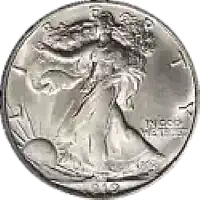
The Walking Liberty half dollar — struck from 1916 through 1947 — is widely considered the finest artistic achievement in the history of American coinage. Designed by sculptor Adolph A. Weinman (who also designed the Mercury dime), the obverse depicts a full-length Liberty draped in the American flag striding confidently toward the rising sun, while the reverse features a powerful American eagle perched on a mountain crag. The design was so admired that it was revived in 1986 for the American Silver Eagle bullion coin, where it remains in use today.
For collectors, the Walking Liberty half dollar series combines genuine artistic beauty with serious numismatic depth. The series spans three decades across three mints — Philadelphia, Denver, and San Francisco — with key dates concentrated in the early years (1916–1921) and the end of the series (1938). The Full Bell Lines (FBL) designation, awarded to coins where the horizontal lines on the Liberty Bell on the reverse are complete and separated, creates a parallel premium market similar to FSB on Mercury dimes. A common-date Walker in MS-65 is worth $80–$150; the same coin with FBL is worth $400–$2,000+. For silver melt value, use our silver melt calculator — each Walking Liberty half contains 0.3617 troy ounces of pure silver.
Walking Liberty Half Dollar Key Dates
The key dates of the Walking Liberty half dollar series are concentrated in two periods: 1916–1921 (low early mintages) and 1938 (the end of production before the series was revived). The 1916-D with obverse mintmark is the most famous variety. The 1921-P and 1921-D are the two scarcest dates by survival population.
1916-D Obverse Mintmark
The rarest regular-issue Walking Liberty half — only 1,014,400 struck at Denver, and on early strikings the D mintmark appeared on the obverse rather than the reverse. The obverse-mintmark variety is the most desirable. PCGS or NGC certification essential — altered mintmarks exist.
G-4: $580 · VF: $1,800 · MS-63: $18,000+1921-P Walking Liberty Half
Only 246,000 struck — the second scarcest date in the series. Most examples are heavily circulated. Even Good-4 examples are worth $180+. MS examples are genuinely rare; MS-63 is worth $8,000+. This and the 1921-D define the upper tier of Walking Liberty collecting.
G-4: $180 · VF: $700 · MS-63: $8,000+1921-D Walking Liberty Half
208,000 struck at Denver — the lowest mintage in the series. Slightly rarer than the 1921-P. Both 1921 dates are dramatically scarcer than any other Walking Liberty half dollar. A complete type set demands one of the two 1921 dates as a centerpiece.
G-4: $200 · VF: $800 · MS-63: $12,000+1916-P & 1916-S
First-year issues from Philadelphia (608,000) and San Francisco (508,000) — both are significant semi-keys. The 1916-S is particularly scarce in gem condition. On 1916-P and 1916-S halves, the mintmark appears on the obverse; starting in 1917 it moved to the reverse.
G-4: $55–110 · VF: $160–280 · MS-63: $3,000–5,000+1938-D Walking Liberty Half
491,600 struck — the lowest-mintage date of the 1930s and the last key date of the series. Most examples were saved in high grades. MS-64 FBL examples are worth $3,000+; MS-65 FBL commands $8,000–$12,000+. The natural cap to any Walking Liberty date set.
G-4: $140 · MS-63: $260 · MS-65 FBL: $8,000+1917-D & 1917-S Obverse Mintmark
In 1917, some Denver and San Francisco halves were struck with the mintmark on the obverse (as in 1916) before the design was standardized to the reverse. The 1917-D Obverse and 1917-S Obverse are scarcer than their reverse-mintmark counterparts and command meaningful premiums.
G-4: $60–90 · VF: $200–350 · MS-63: $4,000–8,000+Complete Walking Liberty Half Dollar Value Chart (1916–1947)
Values are for problem-free, unaltered examples. G = Good-4, VG = Very Good-8, F = Fine-12, VF = Very Fine-20, EF = Extremely Fine-40, MS-63 = Choice Uncirculated, MS-65 = Gem Uncirculated, FBL = Full Bell Lines. Silver melt value per coin is approximately $9.00–$10.50 at current spot — use our silver melt calculator for the live figure. Obv. = obverse mintmark variety.
| Date | G-4 | VG-8 | F-12 | VF-20 | EF-40 | MS-63 | MS-65 | MS-65 FBL | Shop |
|---|---|---|---|---|---|---|---|---|---|
| 1916-P SEMI-KEY | $55 | $80 | $120 | $200 | $420 | $3,000 | $9,500 | — | eBay → |
| 1916-D Obv. KEY | $580 | $900 | $1,400 | $1,800 | $3,500 | $18,000 | $55,000+ | — | eBay → |
| 1916-S SEMI-KEY | $110 | $160 | $240 | $380 | $700 | $5,000 | $18,000+ | — | eBay → |
| 1917-P Rev. | $14 | $18 | $22 | $32 | $60 | $200 | $650 | $3,500 | eBay → |
| 1917-D Obv. SEMI-KEY | $60 | $90 | $140 | $230 | $500 | $4,000 | $14,000+ | — | eBay → |
| 1917-D Rev. | $16 | $22 | $30 | $48 | $95 | $380 | $1,200 | $6,000 | eBay → |
| 1917-S Obv. SEMI-KEY | $90 | $140 | $220 | $380 | $750 | $8,000 | $28,000+ | — | eBay → |
| 1917-S Rev. | $14 | $18 | $24 | $38 | $75 | $280 | $900 | $5,000 | eBay → |
| 1918-P | $14 | $18 | $24 | $38 | $80 | $320 | $1,050 | $5,500 | eBay → |
| 1918-D | $16 | $22 | $30 | $50 | $105 | $420 | $1,400 | $7,000 | eBay → |
| 1918-S | $14 | $18 | $24 | $38 | $80 | $320 | $1,050 | $5,500 | eBay → |
| 1919-P | $18 | $26 | $38 | $65 | $140 | $600 | $2,000 | $10,000 | eBay → |
| 1919-D | $22 | $34 | $55 | $95 | $220 | $900 | $3,000 | $15,000 | eBay → |
| 1919-S | $20 | $30 | $48 | $80 | $180 | $750 | $2,500 | $12,000 | eBay → |
| 1920-P | $14 | $18 | $24 | $38 | $80 | $320 | $1,050 | $5,500 | eBay → |
| 1920-D | $16 | $22 | $32 | $55 | $120 | $500 | $1,650 | $8,500 | eBay → |
| 1920-S | $14 | $18 | $24 | $40 | $90 | $380 | $1,250 | $6,500 | eBay → |
| 1921-P KEY | $180 | $280 | $420 | $700 | $1,600 | $8,000 | $28,000+ | — | eBay → |
| 1921-D KEY | $200 | $320 | $480 | $800 | $1,800 | $12,000 | $45,000+ | — | eBay → |
| 1921-S | $20 | $32 | $50 | $90 | $200 | $900 | $3,000 | $15,000 | eBay → |
The 1921-P and 1921-D are the premier key dates — with mintages under 250,000 each, both require PCGS or NGC certification for any purchase.
Shop 1916–1921 →| Date | G-4 | VG-8 | F-12 | VF-20 | EF-40 | MS-63 | MS-65 | MS-65 FBL | Shop |
|---|---|---|---|---|---|---|---|---|---|
| 1923-S | $14 | $18 | $26 | $44 | $95 | $420 | $1,400 | $7,000 | eBay → |
| 1927-S | $14 | $18 | $26 | $44 | $95 | $420 | $1,400 | $7,000 | eBay → |
| 1928-S | $14 | $18 | $26 | $44 | $95 | $420 | $1,400 | $7,000 | eBay → |
| 1929-D | $14 | $18 | $24 | $38 | $80 | $320 | $1,050 | $5,500 | eBay → |
| 1929-S | $14 | $18 | $24 | $38 | $80 | $320 | $1,050 | $5,500 | eBay → |
| 1933-S | $14 | $20 | $30 | $52 | $115 | $500 | $1,650 | $8,500 | eBay → |
| 1934-P | $13 | $16 | $20 | $30 | $60 | $200 | $650 | $3,000 | eBay → |
| 1934-D | $13 | $16 | $22 | $36 | $75 | $280 | $900 | $4,500 | eBay → |
| 1934-S | $13 | $16 | $20 | $32 | $70 | $260 | $850 | $4,200 | eBay → |
| 1935-P | $13 | $16 | $20 | $30 | $55 | $180 | $580 | $2,800 | eBay → |
| 1935-D | $13 | $16 | $22 | $36 | $75 | $280 | $900 | $4,500 | eBay → |
| 1935-S | $13 | $16 | $20 | $32 | $70 | $260 | $850 | $4,200 | eBay → |
| 1936-P | $13 | $16 | $20 | $30 | $55 | $180 | $580 | $2,500 | eBay → |
| 1936-D | $13 | $16 | $22 | $36 | $75 | $280 | $900 | $4,000 | eBay → |
| 1936-S | $13 | $16 | $20 | $32 | $68 | $250 | $820 | $4,000 | eBay → |
Mid-series Walking Liberty halves are accessible in circulated grades — affordable 90% silver coins with strong FBL premiums in gem condition.
Shop 1923–1936 →| Date | G-4 | VG-8 | F-12 | VF-20 | EF-40 | MS-63 | MS-65 | MS-65 FBL | Shop |
|---|---|---|---|---|---|---|---|---|---|
| 1937-P | $13 | $16 | $20 | $30 | $55 | $180 | $580 | $2,500 | eBay → |
| 1937-D | $13 | $16 | $22 | $36 | $75 | $280 | $900 | $4,000 | eBay → |
| 1937-S | $13 | $16 | $20 | $32 | $68 | $250 | $820 | $3,800 | eBay → |
| 1938-D KEY | $140 | $200 | $280 | $380 | $500 | $260 | $420 | $8,000 | eBay → |
| 1939-P | $13 | $16 | $20 | $28 | $50 | $160 | $520 | $2,200 | eBay → |
| 1939-D | $13 | $16 | $20 | $30 | $55 | $180 | $580 | $2,500 | eBay → |
| 1939-S | $13 | $16 | $22 | $36 | $75 | $280 | $900 | $4,000 | eBay → |
| 1940-P | $13 | $16 | $20 | $28 | $48 | $150 | $480 | $2,000 | eBay → |
| 1940-S | $13 | $16 | $20 | $30 | $55 | $180 | $580 | $2,500 | eBay → |
| 1941-P | $13 | $16 | $20 | $28 | $46 | $140 | $460 | $1,900 | eBay → |
| 1941-D | $13 | $16 | $20 | $30 | $52 | $165 | $540 | $2,200 | eBay → |
| 1941-S | $13 | $16 | $20 | $30 | $55 | $175 | $570 | $2,400 | eBay → |
| 1942-P | $13 | $16 | $20 | $28 | $44 | $135 | $440 | $1,800 | eBay → |
| 1942-D | $13 | $16 | $20 | $28 | $46 | $145 | $475 | $2,000 | eBay → |
| 1942-S | $13 | $16 | $20 | $30 | $52 | $165 | $540 | $2,200 | eBay → |
| 1943-P | $13 | $16 | $20 | $28 | $44 | $135 | $440 | $1,800 | eBay → |
| 1943-D | $13 | $16 | $20 | $28 | $46 | $145 | $475 | $2,000 | eBay → |
| 1943-S | $13 | $16 | $20 | $30 | $52 | $165 | $540 | $2,200 | eBay → |
| 1944-P | $13 | $16 | $20 | $28 | $44 | $135 | $440 | $1,800 | eBay → |
| 1944-D | $13 | $16 | $20 | $28 | $46 | $145 | $475 | $2,000 | eBay → |
| 1944-S | $13 | $16 | $20 | $30 | $52 | $165 | $540 | $2,200 | eBay → |
| 1945-P | $13 | $16 | $20 | $28 | $44 | $135 | $440 | $1,800 | eBay → |
| 1945-D | $13 | $16 | $20 | $28 | $46 | $145 | $475 | $2,000 | eBay → |
| 1945-S | $13 | $16 | $20 | $30 | $52 | $165 | $540 | $2,200 | eBay → |
| 1946-P | $13 | $16 | $20 | $28 | $44 | $130 | $420 | $1,700 | eBay → |
| 1946-D | $13 | $16 | $20 | $28 | $46 | $140 | $460 | $1,900 | eBay → |
| 1946-S | $13 | $16 | $20 | $30 | $50 | $155 | $500 | $2,100 | eBay → |
| 1947-P | $13 | $16 | $20 | $28 | $44 | $130 | $420 | $1,700 | eBay → |
| 1947-D | $13 | $16 | $20 | $28 | $46 | $140 | $460 | $1,900 | eBay → |
The 1938-D is the final key date — low mintage but many saved in high grades. The FBL premium is dramatic: MS-65 without FBL is ~$420, with FBL it reaches $8,000+.
Shop 1937–1947 →Full Bell Lines (FBL) — What It Means & Why It Matters
The Full Bell Lines designation is the defining premium category in Walking Liberty half dollar collecting. On the reverse, the Liberty Bell shows horizontal lines across its lower portion. On a fully struck coin, these horizontal bell lines are complete and clearly separated across the full width of the bell. PCGS designates this as FBL (Full Bell Lines); NGC uses the same designation. Both require expert examination under magnification.
Why FBL Commands a Premium
Walking Liberty halves are notorious for weak striking — the bell detail requires maximum die pressure on a large coin, and most examples show incomplete bell lines. A sharply struck coin with complete bell lines is genuinely scarce for most dates, making FBL examples a distinct sub-series within the type.
How to Identify FBL
Under 5x magnification, examine the horizontal lines across the lower portion of the Liberty Bell on the reverse. These lines must be complete and clearly separated across the entire width of the bell. Partial lines — fading toward one side — do not qualify. Only PCGS FBL or NGC FBL designated coins command the FBL premium.
Most Valuable FBL Dates
The 1921-P and 1921-D have essentially no confirmed FBL examples. The 1938-D MS-65 FBL is worth $8,000–$12,000 — a massive premium over non-FBL MS-65 at ~$420. Early dates (1916–1921) in FBL are condition rarities commanding five-figure prices. Mid-1930s FBL gems are more accessible.
FBL Premium Gap
Common 1940s dates in MS-65: $440–$580 without FBL, $1,700–$2,200 with FBL — roughly 3–4x. For the 1938-D: MS-65 without FBL ~$420, MS-65 FBL ~$8,000–$12,000 — a 19–28x premium. Early dates with FBL examples are essentially priceless relative to their non-FBL counterparts.
Buying FBL Coins
Only buy PCGS FBL or NGC FBL designated examples. Self-identified "full bell lines" in raw holders are frequently incorrect. The distinction requires careful examination under proper lighting — not visible to the naked eye on many coins. The designation must appear on the PCGS or NGC certification label.
FBL Complete Sets
A complete Walking Liberty half dollar set in MS-65 FBL is one of the most ambitious goals in 20th-century numismatics. Many early dates have population reports in the single digits for MS-65 FBL. Serious FBL set builders should expect a multi-decade collecting horizon for the key early dates.
Shop Walking Liberty Half Dollars on eBay
Browse certified PCGS and NGC Walking Liberty halves — key dates, FBL designated gems, 90% silver bullion-grade rolls, and complete date sets from specialist dealers nationwide.
📚 Walking Liberty References on AmazonFindRareCoins.com participates in the eBay Partner Network and Amazon Associates program.
Where to Buy Walking Liberty Half Dollars
Certified Key Dates · Bullion-Grade 90% Silver · FBL Specialists
For key dates (1921-P, 1921-D, 1916-D Obverse), PCGS or NGC certification is essential. For common circulated dates as a silver position, raw coins are widely available. Each Walking Liberty half contains 0.3617 oz of silver — making even worn examples worth $9–$10 at current spot prices.
eBay — Certified Walking Liberties
The broadest market for certified and raw Walking Liberty halves — filter to PCGS or NGC for key dates and FBL gems. Check sold listings before bidding to verify current market prices.
Shop Certified on eBay →JM Bullion
JM Bullion carries circulated Walking Liberty halves and rolls priced near silver melt — ideal for investors buying 90% silver as a bullion position. Competitive premiums with insured shipping.
Shop JM Bullion →Heritage Auctions on eBay
Heritage Auctions handles the finest Walking Liberty key dates — their free price archive documents every major 1921-P, 1921-D, and 1916-D Obverse sale. Essential research before any key date purchase.
Find Key Dates on eBay →Money Metals Exchange
Money Metals Exchange carries Walking Liberty half rolls and individual coins with no minimum order. Good source for investors buying 90% silver halves at competitive premiums over melt value.
Shop Money Metals →PCGS FBL-Designated on eBay
Filter eBay to PCGS-certified Walking Liberty halves with the FBL designation for authenticated Full Bell Lines examples at every grade level. The designation must appear on the certification label.
Shop PCGS FBL →Walking Liberty References on Amazon
David Bullowa's definitive Walking Liberty half dollar reference and the Cherrypickers' Guide cover all major varieties, FBL attribution standards, and population data for serious collectors.
Browse Amazon →Related Coin Value Guides
Frequently Asked Questions
What is the most valuable Walking Liberty half dollar?
The 1921-D is the most valuable Walking Liberty half dollar by mintage — only 208,000 were struck at Denver, making it the lowest-mintage date in the series. In Good-4 condition a certified example is worth $200+; in MS-65 condition $45,000+. The 1916-D with obverse mintmark has a slightly higher mintage (1,014,400) but commands extraordinary prices in gem grades — MS-65 examples have sold for $55,000+. The 1921-P (246,000 mintage) completes the top tier of key dates. Both 1921 dates and the 1916-D obverse are the three coins that define the Walking Liberty series for serious collectors.
How much silver is in a Walking Liberty half dollar?
Each Walking Liberty half dollar contains 0.3617 troy ounces of pure silver (90% silver, 10% copper, 12.50 grams total weight). At a silver spot price of $25/oz, the melt value is approximately $9.04 per coin. At $30/oz spot, melt value is approximately $10.85. Use our silver melt calculator for the live figure. Even heavily worn common-date Walking Liberty halves in Good condition are worth $13+ — primarily because the silver content establishes a strong floor above their nominal face value of 50 cents.
What does Full Bell Lines (FBL) mean on a Walking Liberty half?
Full Bell Lines (FBL) refers to the complete, fully separated horizontal lines on the lower portion of the Liberty Bell on the reverse. Walking Liberty halves are notoriously weakly struck in the bell area — most examples show incomplete or merged bell lines. PCGS and NGC award the FBL designation only to coins where the lines are fully defined across the entire width of the bell under proper examination. An MS-65 FBL coin is typically worth 3–5x a non-FBL MS-65. For the 1938-D, the FBL premium reaches 19–28x. Never pay FBL prices for an undesignated coin regardless of how sharp it appears visually.
What is the mintmark position difference on 1916–1917 halves?
When the Walking Liberty half dollar was first issued in 1916, the mintmark for Denver (D) and San Francisco (S) issues was placed on the obverse — on Liberty's skirt just above the motto IN GOD WE TRUST. Starting in 1917, the mintmark was moved to the reverse, below the motto on the left side. In 1917, both obverse and reverse mintmark positions exist — the 1917-D Obverse and 1917-S Obverse are scarcer and more valuable than their reverse-mintmark counterparts. After 1917, all Walking Liberty halves have the mintmark on the reverse. This obverse mintmark variety is a key distinction for collectors of early-date Walkers.
Are Walking Liberty half dollars a good silver investment?
Investment decisions should be made with professional guidance — nothing here constitutes financial advice. The factual case for Walking Liberty halves as a silver holding is that each coin contains 0.3617 oz of silver, they are universally recognized by dealers, they are legal tender, and their 90% silver content is easy to verify by weight. Common circulated examples trade at modest premiums above melt — typically $13–$16 per coin — making them one of the most accessible 90% silver accumulation vehicles. Key date and FBL gem examples have a separate investment thesis based on numismatic rarity and collector demand, which has historically been independent of spot silver prices.
Where can I find current Walking Liberty half dollar prices?
This value chart is updated periodically. For real-time prices, use the PCGS Price Guide at PCGS.com (updated monthly), recent eBay sold listings filtered to certified examples, and Heritage Auctions' free price archive. The FRC coin price guide covers the Walking Liberty series alongside all major U.S. denominations. For current silver melt values, the silver melt calculator provides a live figure based on current spot prices.
 '
'