What Record Silver Prices Mean for Your Coin Collection in 2026
Silver spiked to a record $121.67/oz in January — then gave most of it back. Here's what that historic run means for Morgan dollars, junk silver, and the coins sitting in your collection right now.
If you collect coins with silver in them — Morgan dollars, Walking Liberty halves, Roosevelt dimes, junk silver — 2026 has been one of the most consequential years in memory. Silver hit an all-time nominal high of $121.67 per ounce on January 29, 2026, gaining roughly 70% in the month of January alone, before collapsing hard in February and settling into a lower, still-elevated range. As of this writing (August 21, 2026), silver trades around $70 per ounce — down more than 40% from the January peak, but still historically strong.
For coin collectors, this isn't just a precious metals story. It's a story about the coins in your collection, the ones you might sell, and the ones worth buying right now before the market catches up.
January 29 all-time high: $121.67/oz
Current price: ~$70/oz
Down from the January peak: ~42%
Prices move fast — check our live Gold & Silver Spot Price Tracker for the current figure before making any buy or sell decision.
Why Silver Prices Matter to Coin Collectors
Most U.S. silver coins minted before 1965 contain 90% silver. That means their melt value — the value of the metal alone — rises and falls with the silver spot price. At today's roughly $70/oz, a common-date Morgan dollar (0.7735 troy oz of pure silver) contains approximately $54 worth of silver. At the January peak of $121.67/oz, that same coin's melt value briefly touched $94.
This matters for three reasons: it sets a hard floor on what dealers will pay for silver coins, it compresses the spread between common and key-date coins (when silver spikes, common dates become scarce too), and it pulls new buyers into the hobby who previously saw silver coins as "just old change."
The Coins Most Affected by the Silver Surge
Morgan Silver Dollar
Junk Silver Coins
Walking Liberty Half Dollar
Silver Roosevelt Dime
Peace Dollar
Franklin Half Dollar
For a full breakdown of junk silver values at current spot prices, see our Junk Silver Coins Value Guide. For live spot prices, check our Gold & Silver Spot Price Tracker.
What the Gold/Silver Ratio Tells Collectors
The gold/silver ratio — how many ounces of silver it takes to buy one ounce of gold — has been one of the most-watched numbers in precious metals in 2026. At the January spike, the ratio briefly compressed to below 45:1 as silver massively outran gold. It has since widened back out considerably: as of late August 2026, the ratio sits closer to 65–70:1, with gold holding firm near $4,475/oz while silver gave back a much larger share of its earlier gains.
Historically, a ratio above 80:1 has signaled that silver is undervalued relative to gold, while a ratio below 50:1 has typically marked overheated, speculative silver conditions. At the current ratio of roughly 65–70:1, silver sits in a more moderate middle ground — no longer at the extreme cheapness of a sub-45 ratio, but also well off the historically stretched 80+ readings of past silver bear markets.
Should You Buy, Hold, or Sell?
This is the question every collector is asking in 2026. Here's a straightforward framework — not investment advice, just a way to think about the decision:
Buy if you're looking at key-date silver coins in problem-free, certified condition. The spread between common and scarce dates tends to widen when metal prices are elevated — meaning key dates become relatively more attractive. The 1893-S Morgan Dollar, 1921 Peace Dollar, and 1838-O Capped Bust Half are all coins where numismatic premium far exceeds melt value and tends to hold through price corrections.
Hold common-date silver coins you already own. With silver still historically elevated well above its 2024 levels, and institutional forecasts split between further gains and continued consolidation, selling common Morgans or junk silver bags purely out of anxiety about short-term swings may mean leaving upside on the table.
Sell if you have duplicates of common dates in circulated condition — AG-3 through VF-30 Morgans with no key dates or mint marks. These trade near melt, and even after the pullback from January, current prices represent a historically strong exit for coins purchased at $17–$20/oz silver.
Check Your Coin Values
Use our Coin Price Guide to see what your silver coins are worth at today's spot price.
View the Coin Price Guide →Error Coins: The Other Big Story of 2026
Alongside the silver surge, error coins have emerged as one of the most-searched coin topics of 2026. Social media has driven massive awareness of mint errors, and searches for terms like "1955 doubled die penny," "1943 copper penny," and "2026 quarter errors" have surged across Google.
Error coins represent one of the best opportunities in the current market precisely because their value is independent of metal content. A 1943 copper penny worth $60,000–$200,000+ carries a fraction of a cent's worth of copper. The value is entirely in the error — which means swings in silver and gold prices have zero effect on their collector value.
Our Complete Error Coins Value Guide covers the most valuable mint errors in U.S. history, what to look for, and what they're worth today.
Where to Buy Silver Coins Right Now
JM Bullion
Kitco
Money Metals Exchange
SD Bullion
Silver Gold Bull
eBay
Amazon — Reference Guides
FRC Coin Price Guide
 Find Silver Coins on eBayMoney Back Guarantee
FindRareCoins.com participates in the eBay Partner Network, Amazon Associates, and AWIN affiliate programs. Purchases made through links on this page may earn us a commission at no additional cost to you.
Frequently Asked Questions
How much silver is in a Morgan dollar?
A Morgan dollar contains 0.7735 troy ounces of pure silver. At around $70/oz, that's approximately $54 in melt value. At the January 2026 peak of $121.67/oz, melt value briefly reached about $94. Check our live spot price tracker to calculate today's exact figure.
What is junk silver and is it worth buying in 2026?
Junk silver refers to pre-1965 U.S. dimes, quarters, and half dollars containing 90% silver. They carry no numismatic premium but trade near melt value, making them a straightforward way to buy silver at low premiums over spot. Even after silver's pullback from its January high, many collectors still consider junk silver good value compared to modern rounds or bars.
Will silver prices go higher in 2026?
We don't offer investment advice, and forecasts vary widely — institutional estimates for the rest of 2026 have ranged from the low $60s to over $100/oz depending on the source and their assumptions about Federal Reserve policy, the US dollar, and industrial demand from solar and AI infrastructure. Track our live spot price tracker for current data rather than relying on any single forecast.
Are error coins affected by silver prices?
No. Error coin values are driven entirely by collector demand and rarity, not metal content. A 1943 copper penny worth $60,000–$200,000+ contains a fraction of a cent's worth of copper — its value comes from its status as a rare mint error, making it completely independent of commodity markets.
Why did silver fall so much after the January 2026 peak?
Several factors converged: exchanges raised margin requirements on silver futures, forcing leveraged traders to sell; the U.S. dollar strengthened as expectations for Federal Reserve rate cuts faded; and the metal simply gave back some of an extraordinary run that had already seen it gain roughly 147% in 2025 alone. Sharp pullbacks after speculative peaks are common in silver's history — the same pattern followed both the 1980 and 2011 price spikes.
Where can I find the current silver spot price?
FindRareCoins.com maintains a live Gold & Silver Spot Price Tracker updated in real time. Given how quickly silver has moved in 2026, bookmark it and check it directly before making any buying or selling decision rather than relying on a fixed number from an article.
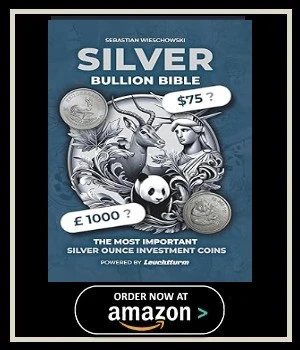
Silver Bullion Bible is a globe‑spanning guide that explores the investment appeal of one‑ounce silver bullion coins—from iconic series like the Maple Leaf, Panda, Koala, Libertad, Britannia, to the American Silver Eagle

 '
'